

Sheep Shearing in The Old Days
www.burford.on.ca
Copyright © 2003 - 2026
All rights reserved
Published 2023-04-25
(Copyright © 2003 - 2026 by Clayton Barker)
"Baa Baa Blacksheep
Have you any wool?
Yes sir, yes sir,
Three bags full..."
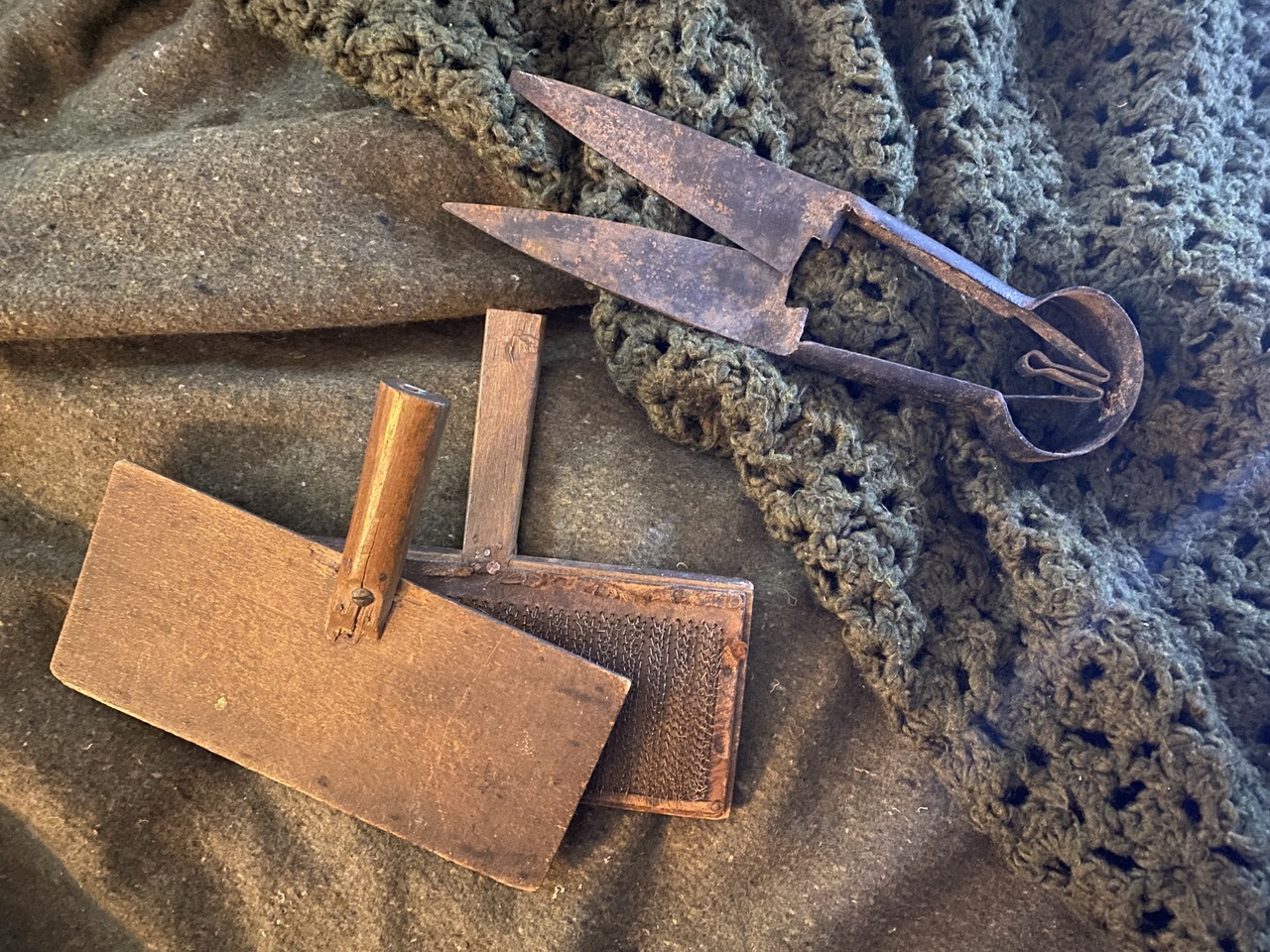
The answer to the mystery ArtiFACT question was of course - Carding Brushes / Hand Carders ("hand paddles")
and "Sheep sheers"
Shearing:
"... Before electric shears, sheep were sheared with hand shears or blades."
"To shear sheep today, many sheep farmers use electric shears. But before electric shears were invented, they used hand shears. Hand-shearing is common in areas where electricity is limited. A hand-sheared sheep will produce more wool than an electric-sheared sheep..."(mom.com)
Carding:
"Carding or combing wool is a necessary step in the process of making wool cloth. Carding makes sure all the wool fibers are untangled and aligned in one direction, making it easier to spin smoothly." (historiclondontown.org)
"The word is derived from the Latin Carduus meaning thistle or teasel,[3] as dried vegetable teasels were first used to comb the raw wool before technological advances led to the use of machines..."(wikipedia)
Fulling:
"Fulling, also known as tucking or walking, which is a step in woollen clothmaking which involves the cleansing of woven cloth (particularly wool) to eliminate (lanoline) oils, dirt, and other impurities, and to make it shrink by friction and pressure.(wikipedia).
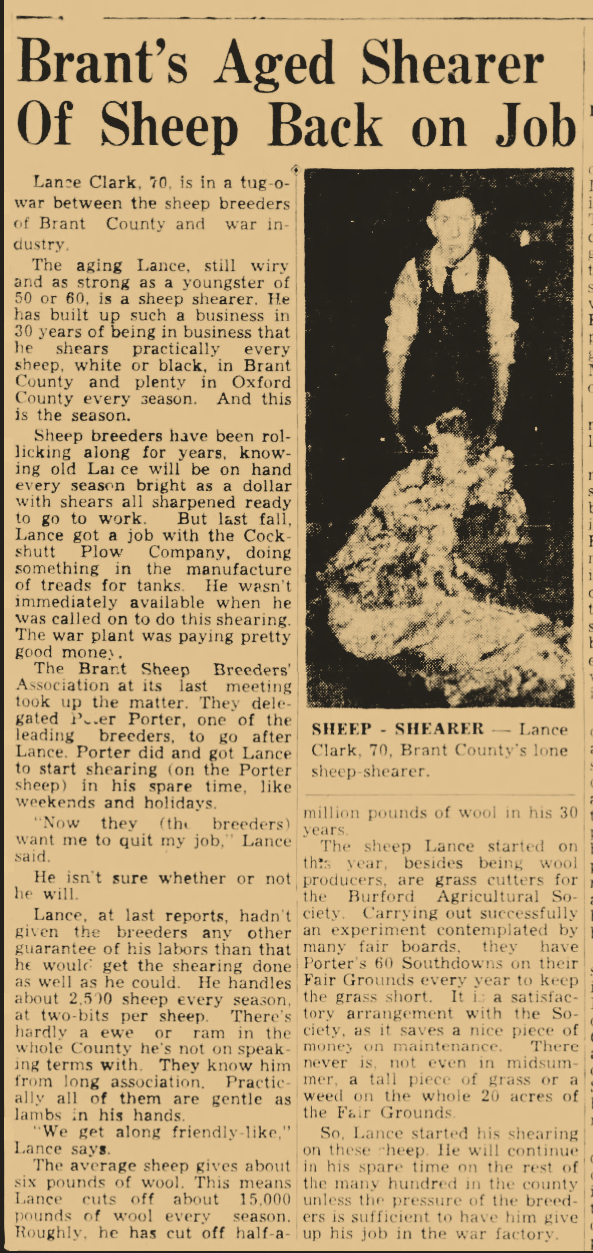
The Old Sheep Shearer: Lance Clark, Burford
There was a demand for wool during the world wars but also a demand in the manufacturing of war machines (tanks). Cockshutt Plow Company of brantford transitioned to making treads for tanks and the money was really good and more dependable than sheep sheering.
In 1944 Burford's renowned sheep shearer, Lance Clark, was in demand for sheering and the Burford breeders "rounded him up", even though it was only to be done on his spare time.
According to the accompanying article [Brantford Expositor from April 1944] Lance was on "speaking terms" with about 2,500 sheep in the district and sheared 15,000 pounds of wool per season, which they estimated equalled about half-a-million pounds of wool that he had sheered in his thirty years of doing it.
It is interesting to note that the local sheep were not only wool producers but also lawn cutters for the Burford Agricultural Society...hmmm. In light of the towering price of gas these days, and the acres and acres of grass still to be found and needing to be cut (so dang often!, perhaps this would be a thing to do - again? On my way to Simcoe, in Norfolk, I regularly see herds of sheep temporarily penned in the fields and orchards utilizing the growth, what comes naturally.
Lance answered the call to duty though he was seventy years old and ready to retire from it. He had been doing most of the sheep shearing in the district since the turn of the 20th century.
First Carded Roll in Upper Canada / Burford Township:
Henry Lester, One of Burford's earliest settlers, was born in Bennington Vermont. At age 15 Henry apprenticed as a Fuller but was through with being harshly treated by his employer by age and settled at Niagara-on-the-Lake ("Shipman's Corners now St. Catherines) where he constructed the first woollen mill in Upper Canada. At age 23, Henry disposed of his interests in that first mill and settled in Burford about 1810, first near the present village site, then after the War of 1812-14 settled south-west of the village on a farm adjacent to what is now the Harley Road.(R.C.Muir,1920).
NOTE: Muir incorrectly notes the location of Lester as Lot 4 Concession Six, but refers to it as the old "Andrew Miller Farm," therefore Lester had settled on Lot 3 Concession Six, which later became the North-East quadrant of the present village and the old Luard and Millar properties.
Muir does mention however that in the year 1817 Burford Township had "one fulling mill, one carding machine, and the cost of carding was Six pence per pound."
Henry Lester was active in Burford's/Oxford County's first militia serving as Quartermaster Sergeant all through the war. Lester is known to have participated at the Battle of Lundy's Lane.
Woolen Mills:
"In the early 1800s small water-powered mills began to offer settlers' wives some relief from the tedious and unpleasant tasks of carding and fulling by hand. By the 1840s woollen mills and factories had made their appearance in Upper Canada. These mills were able to clean and card wool, spin it into yarn, and weave and fold cloth. Like most other mills, they were water-powered..."(uppercanadavillage.com)
Fulling Mill:
The presence of carding and fulling mills in the early 1800’s would greatly lessen the time spent on these labourious tasks. A carding mill would perform the tasks of washing, picking and carding the wool into batts for use in making quilts, or roving for hand spinning. A fulling mill would ‘full’ the woven cloth, beating and working the wet cloth to shrink, thicken, and strengthen it before finishing for blankets and/or cutting to make clothing or other items from. (kilbridehistory.com)
--------------------------------------------
ACCOMPANYING IMAGE/CLIPPING:
From the Brantford Expositor April 1944, taken from an old scrap book given to me thirty years ago.
--------------------------------------------
DISCLAIMER
The information contained on this page represents the research findings and opinions of the author. The material on this page reflects the author’s best judgement in light of the information available at the time of compilation. Any use of this material made by a third party, or reliance on, or decisions made based on it are the responsibility of such third parties. The author accepts no responsibility for damages, if any, suffered by any third party as a result of decisions made or actions based on this work.


"The Lone Oak," sketch
Copyright © 2011-2026 by Clayton Barker
"The past actually happened but history is only what someone wrote down"
Whitney Brown